
Introduction:
Find the right balance of power, productivity and price — a practical guide to Combine Harvester prices (Wheat & Paddy), an in-depth look at the Wenovus MW-CH110, and buying tips for Indian & regional farms.
Understanding Maijo Combine Harvester Price in Today’s Farming Economy
With rising labour costs, shorter harvesting windows, and increasing pressure to improve crop yield quality, investing in a combine harvester has become a necessity rather than a luxury for modern farmers. Whether you are harvesting wheat or paddy, choosing the right machine at the right combine harvester price directly impacts your farm’s profitability.
Farmers today actively search for information on Agricultural Harvester prices, especially reliable and performance-driven models such as the CH110 harvester and the Wenovus MW-CH110 Combine Harvester. These machines are designed to handle multi-crop harvesting efficiently, reduce grain loss, and save time during peak seasons.
Typical price ranges (quick reference)
- Entry / mini combines (small farms, simple headers): approx. ₹5–15 lakhs (India), often 15–60 HP range combine crawler.
- Mid-range self-propelled combines (most small-to-medium farms): ₹15–28lakhs — suitable for wheat & paddy, 60–120 HP class.
- High-capacity & specialised harvesters: ₹30 lakhs+ — higher HP, larger headers, advanced residue management and comfort features.
Note: quoted price ranges vary significantly by region, import duties, attachments (headers), and dealer support/warranty. Always get an itemised quote that separates machine price, header(s), transport, and on-site commissioning.
Spotlight: Wenovus MW-CH110 (CH110) — what it is and how it’s priced
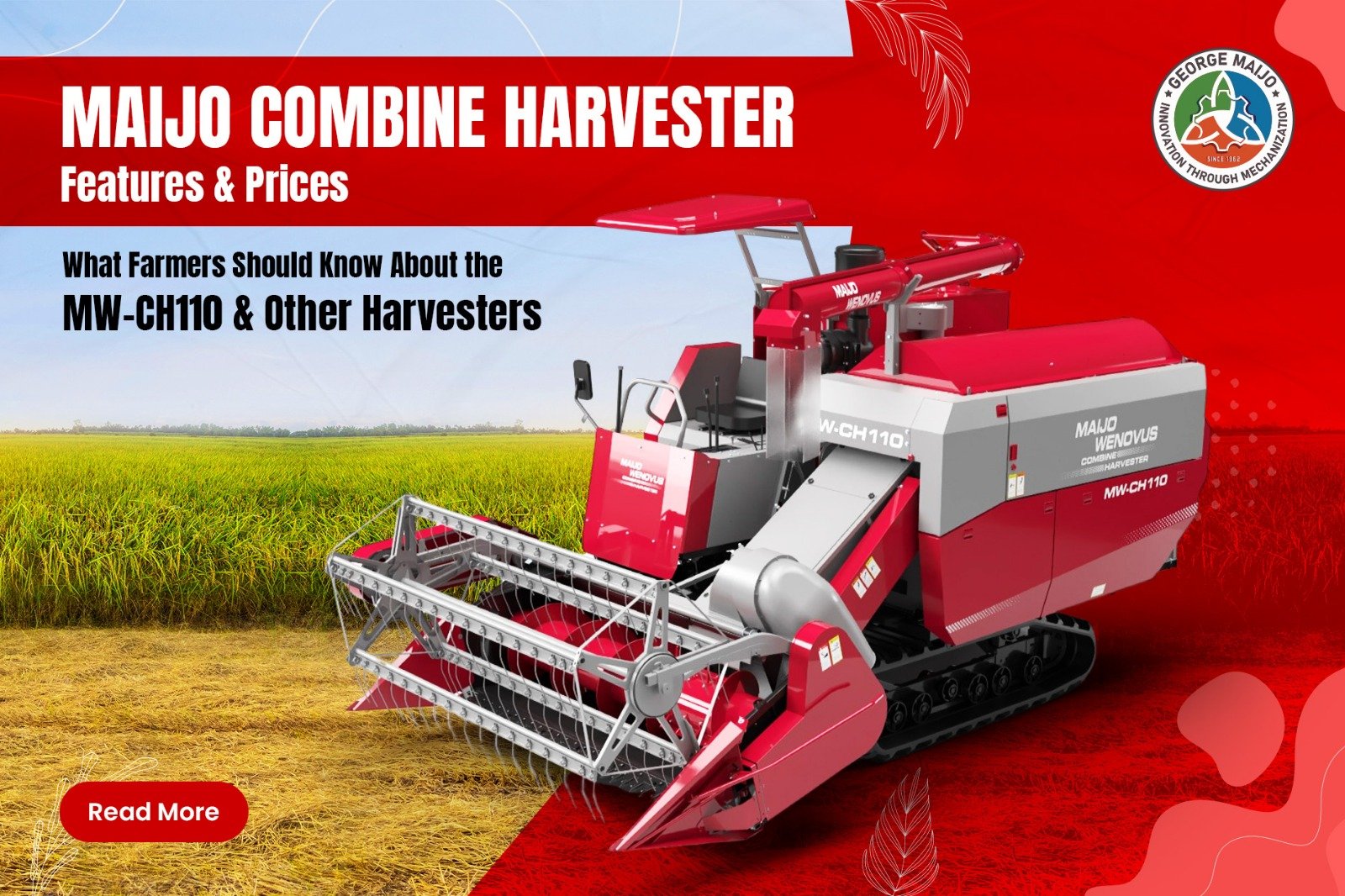
What the MW-CH110 is: The Wenovus MW-CH110 is a 110 HP crawler combine harvester marketed for rice, wheat, rapeseed and similar multi crops. It’s positioned as a high-productivity, multi-crop harvester with rubber tracks (for low ground pressure) and a substantial feeding/threshing capacity — making it attractive for farms that need traction in wet paddy fields or soft soils. Manufacturer listings and supplier pages show the MW-CH110 as a commercial model sold through authorized sales dealers across India.
Price expectations: Manufacturer/wholesale listings on trade platforms often show very broad FOB reference prices (these are not retail quotes). For local pricing you should expect the final landed INR price to reflect import duty, GST, transport, and dealer margin. In practice, competitive 100–120 HP class combines that are imported or branded for commercial operation sit in the mid-range to upper-mid price bracket listed above (₹20–28 lakhs in India), depending on configuration.
In this guide, we simplify:
- Current combine harvester price trends
- Wheat Combine Harvester vs Paddy Combine Harvester pricing
- Key specifications and expected MW-CH110 harvester price
- Why the Wenovus MW-CH110 Harvester is gaining popularity among Indian farmers
If you’re planning to invest in a Maijo combine harvester or evaluating options for your next harvest season, this article will help you make an informed, ROI-driven decision.
Key factors that change the price (and the value)
When comparing quotes, score each machine on these variables — don’t just pick the lowest number:
- Header width & type: wider headers = fewer passes but cost more; multi-crop headers add value.
- Engine power and drivetrain: HP and whether it’s wheel or track (tracks cost more but lower compaction).
- Threshing & cleaning capacity: measured in kg/s or t/h — higher capacity reduces harvest time.
- Residue management tech (SMS, chopper, spreader): required in many states for stubble control.
- Warranty & local service network: Low cost machines with poor support can cost more over 3 years.
- Spare parts availability & consumables: Lead time and fast-moving essential parts.
- Operator comfort & safety features: Adjustable seat, fan, controls ergonomics, and visibility.
Practical checklist before you buy
- Calculate your harvesting window: how many acres, and how many days do you need to finish?
- Match header width to field shape: narrow, irregular fields benefit from smaller headers.
- Ask for measured throughput: request kg/s or t/h performance numbers from dealers.
- Get a total cost of ownership (TCO) estimate: include fuel, service, tracks, and expected downtime.
- Confirm local compliance: in some Indian states combinations must have Super SMS/FMTTI certification.
- Request a demo / trial harvest: inspect grain quality, losses and ease of maintenance.
- Service & spare parts: check the availability of parts and coordinate with the dealer for further support.
Financing, subsidies & cost-mitigation tips
- Government subsidies: Many states run farmer subsidy schemes for harvesters or farm-mechanisation packages; check district agriculture office.
- Custom hiring model: If acreage is limited, consider contract harvesting — hire a machine per acre/day instead of buying.
- Group ownership or cooperatives: Shared ownership reduces per-farm capital outlay and increases utilization.
- Trade-in & seasonal discounts: dealers often offer trade-in allowances on old combines and off-season rates.
Conclusion: Is the MW-CH110 Combine Harvester Worth the Price?
When evaluating the Maijo combine harvester price, it’s important to look beyond the initial cost and focus on long-term productivity, durability, and service support. Machines like the Wenovus MW-CH110 Harvester is designed for farmers who want consistent performance across multi crop specially for paddy and wheat harvesting seasons.
While the combine harvester price may appear high initially, the return on investment becomes evident through:
- Faster harvesting cycles
- Reduced crop losses
- Lower labour dependency
- Higher annual field coverage
For farmers with medium to large landholdings—or those planning to operate under a custom hiring model—the MW-CH110 harvester price is justified by its output, reliability, and versatility as an advanced Agricultural Harvester.
To get the latest Maijo combine harvester price, live demo availability, and financing options, it’s recommended to connect with an authorised George Maijo dealer. This ensures transparent pricing, genuine spare parts, and long-term service support.
Q & A — Buyer’s quick answers
Q: What’s the difference between a wheat combine and a paddy combine?
A: Core threshing principles are same; differences lie in header design, track vs wheel options (paddy often needs lower compaction), and moisture handling — paddy combines commonly include features for wet field operation.
Q: Is the MW-CH110 suitable for small farms?
A: MW-CH110 (110 HP) is best for small, medium to larger holdings or contractors.
Q: How quickly will a 110 HP combine pay for itself?
A: That depends on acreage harvested per year, hire rates saved, reduction in losses, and local labour costs. Create a TCO model: (capital cost + 3-yr operating cost) ÷ acres harvested = cost per hectare vs hiring cost.
Q: Where can I see a demo or get the exact MW-CH110 price?
A: Contact your local dealer Contact Us and request a site demo and an itemised quotation including transport, taxes and commissioning.